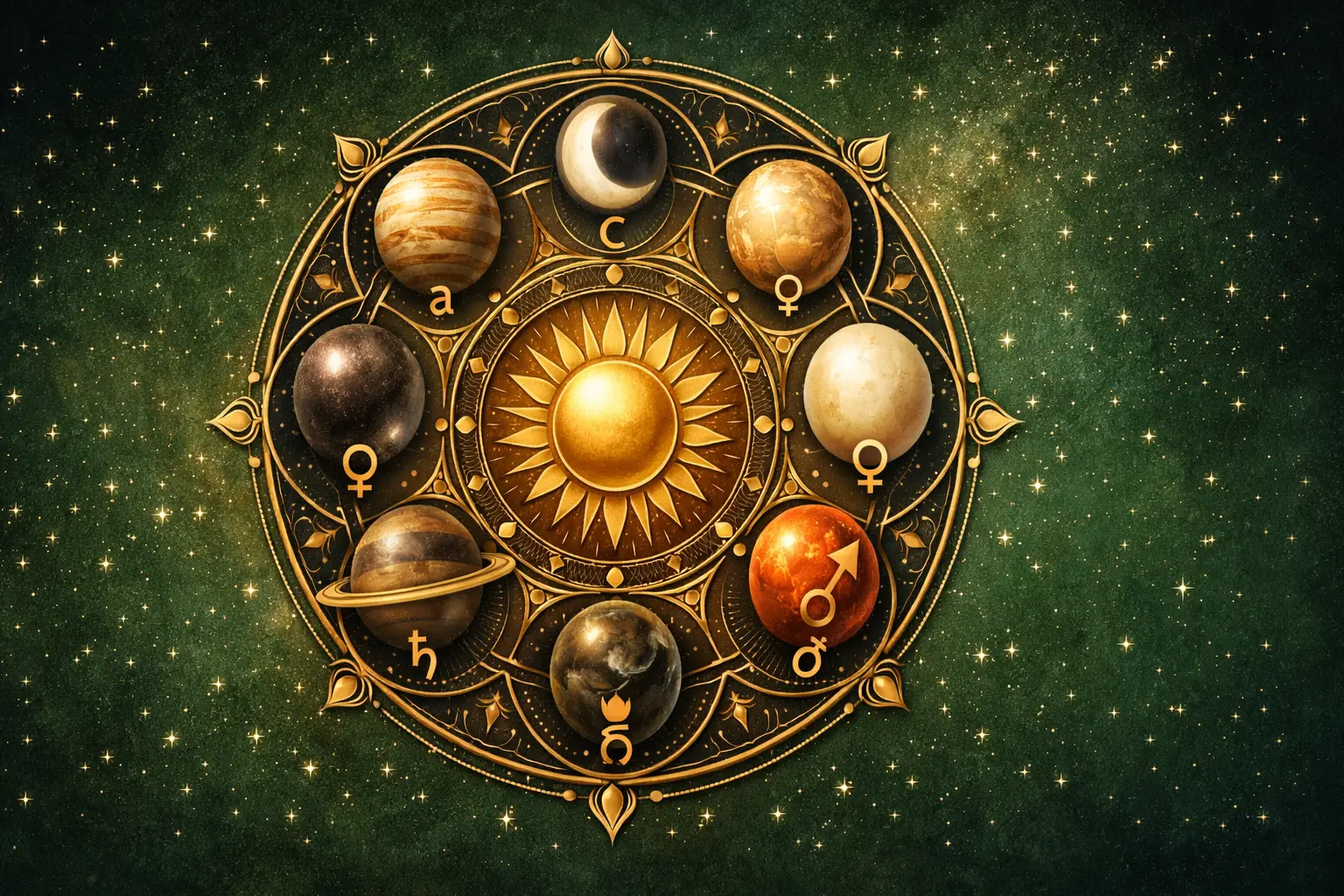
Understanding planetary relationships is fundamental to interpreting any Vedic astrology chart. Just as people form friendships and rivalries, planets in Jyotish have natural affinities and conflicts that profoundly influence their effects in your horoscope.
When planetary relationships in Vedic astrology are judged correctly, the chart reveals strength patterns, yoga formations, dasha outcomes, and remedy strategies that remain hidden without this knowledge. The same conjunction produces different results when planets are friends versus enemies. The same dasha period unfolds differently when the dasha lord is friendly to your ascendant lord versus hostile.
This guide covers natural friendships, temporal relationships, the panchadha maitri system, and how planetary relationships determine yoga strength, aspect quality, and remedy effectiveness across different chart configurations.
Key Takeaways
- Planetary relationships determine how planetary energies combine in conjunctions, aspects, and house placements.
- There are three natural relationship categories: friends (mitra), enemies (shatru), and neutral (sama).
- Temporal relationships based on house placement create a second layer of friendship or enmity.
- Combined natural and temporal relationships produce five final categories in the panchadha maitri system.
- Friendly planets placed together amplify positive results; enemy planets create tension or mixed outcomes.
- Many significant yogas depend on planetary friendships for full activation.
- Understanding relationships guides gemstone selection, mantra practice, and dasha interpretation.
Table of Contents (Click to Jump)
- What Are Planetary Relationships in Vedic Astrology
- Planetary Relationships at a Glance
- Complete Natural Planetary Relationship Chart
- Why Planetary Friendships and Enmities Matter
- How Planetary Relationships Affect Your Birth Chart
- Temporal Relationships: The Second Layer
- Panchadha Maitri: The Five-Fold Friendship System
- Planetary Yogas Through Relationships
- Planetary Aspects and Relationships
- Practical Applications for Chart Reading
- The Shadow Planets: Rahu and Ketu
- Strength and Dignity Modifications
- Timing Triggers: Dashas and Relationships
- Remedies Based on Planetary Relationships
- Mistakes to Avoid
- Case Studies
- Common Questions
- Disclaimer
- Contact
What Are Planetary Relationships in Vedic Astrology
In Vedic astrology, there are nine planetary bodies (Navagraha): Sun, Moon, Mercury, Venus, Mars, Jupiter, Saturn, Rahu, and Ketu. Each planet maintains specific relationships with the others, categorized as:
Friends (Mitra) - Planets that support and enhance each other’s qualities. When friendly planets conjoin or aspect each other, their energies amplify constructively.
Enemies (Shatru) - Planets whose energies conflict or undermine one another. Enemy planets placed together can diminish each other’s benefits or create challenges that require conscious navigation.
Neutral (Sama) - Planets with neither particularly positive nor negative influence on each other. Neutral relationships allow planets to function independently without strong modification.
These relationships are rooted in the intrinsic nature of each planet and remain constant across all charts. They are called natural relationships (Naisargika Maitri) and form the foundation for understanding how planetary energies interact.
A complete reading of planetary relationships in astrology requires examining both natural relationships and temporal relationships based on the specific birth chart configuration.
Planetary Relationships at a Glance
Planetary Relationships Framework
| Relationship Type | Function | Application |
|---|---|---|
| Natural (Naisargika) | Permanent friendships based on planetary nature | Foundation for all relationship analysis |
| Temporal (Tatkalika) | House-based friendships in specific charts | Modifies natural relationships in individual horoscopes |
| Combined (Panchadha) | Five-fold system merging natural + temporal | Final relationship status for precise prediction |
| Conjunction Impact | How planets behave when placed together | Determines yoga strength and mixed results |
| Aspect Modification | How drishti changes based on relationships | Affects supportive versus challenging aspects |
| Dasha Outcomes | How planetary periods unfold | Shapes life chapter results and transitions |
Complete Natural Planetary Relationship Chart
Here is the comprehensive guide to natural planetary friendships in Vedic astrology:
Natural Planetary Relationships (Naisargika Maitri)
| Planet | Friends | Enemies | Neutral |
|---|---|---|---|
| Sun | Moon, Mars, Jupiter | Venus, Saturn, Rahu, Ketu | Mercury |
| Moon | Sun, Mercury | Rahu, Ketu | Mars, Jupiter, Venus, Saturn |
| Mercury | Sun, Venus | Moon, Rahu, Ketu | Mars, Jupiter, Saturn |
| Venus | Saturn, Mercury | Sun, Moon | Mars, Jupiter |
| Mars | Sun, Moon, Jupiter | Mercury | Venus, Saturn |
| Jupiter | Sun, Moon, Mars | Mercury, Venus | Saturn |
| Saturn | Mercury, Venus | Sun, Moon, Mars | Jupiter |
| Rahu | Saturn, Mercury, Venus | Sun, Moon, Mars | Jupiter |
| Ketu | Saturn, Mercury, Venus | Sun, Moon, Mars, Jupiter | None |
These relationships derive from each planet’s rulership over signs. A planet considers lords of the 2nd, 3rd, 4th, 10th, 11th, and 12th signs from its own sign as friends. Lords of the 1st, 5th, 6th, 7th, 8th, and 9th signs are enemies. Lords of signs where a planet is exalted become neutral if not already friend or enemy.
Why Planetary Friendships and Enmities Matter
When analyzing a Vedic astrology chart or horoscope, planetary relationships reveal critical dynamics:
Strength of planetary effects
Friendly planets placed together amplify positive results. A planet in a friend’s sign gains strength (similar to being in own sign or exaltation). Enemy planets can diminish each other’s benefits or create internal conflict that requires conscious resolution.
Yoga formations
Many auspicious combinations (yogas) depend on friendly planets occupying specific positions. Raja yogas often require friendly lords of kendras (1st, 4th, 7th, 10th) and trikonas (1st, 5th, 9th) to connect. Enemy planet combinations may create doshas (afflictions) that block prosperity or create obstacles.
Dasha period results
The planetary periods (mahadasha, antardasha) you experience throughout life are colored by whether the dasha lord is friendly or inimical to your ascendant lord and other chart significators. A friendly planet’s dasha brings supportive growth; an enemy planet’s period may bring challenges that build character through friction.
Aspect quality
When planets aspect each other, the relationship determines whether that aspect is supportive or challenging. A friendly planet’s aspect strengthens the aspected house or planet; an enemy planet’s aspect may create tension or require extra effort to manifest positive results.
Remedy effectiveness
Understanding which planets are allies helps determine the most effective gemstones, mantras, or other Vedic remedies. Strengthening a friendly planet through remedies typically supports your chart; strengthening an enemy planet requires careful judgment based on house lordships and overall chart configuration.
How Planetary Relationships Affect Your Birth Chart
Friendly planet conjunctions
When friendly planets come together in a horoscope, they create harmonious energy combinations that amplify each other’s significations.
Jupiter and Moon conjunction - This combination enhances wisdom, emotional intelligence, and spiritual inclination. When both planets are well-placed in kendras (1st, 4th, 7th, 10th houses), this forms Gaja Kesari Yoga, one of the most auspicious combinations in Vedic astrology. It brings success, respect, and elevated social standing.
Sun and Mars conjunction - This pairing combines leadership authority with courage and decisive action. While both are fiery planets that can create heat if afflicted, when well-placed this combination is beneficial for careers in government, military, law enforcement, or entrepreneurship. The native gains ability to command and execute with confidence.
Venus and Saturn conjunction - Despite being friends, this combination blends artistic sensibility with discipline, structure, and longevity. Saturn’s influence on Venus can delay marriage or romantic fulfillment but ultimately brings lasting, mature relationships. This conjunction supports careers in art, design, architecture, or any field requiring aesthetic sense combined with technical precision.
Mercury and Venus conjunction - This friendly combination creates talent in communication, arts, business negotiation, and creative expression. It supports careers in media, advertising, writing, design, diplomacy, or sales. The native typically has charm, persuasive ability, and aesthetic intelligence.
Enemy planet combinations
Enemy planets placed together create tension, but this tension can be productive when channeled correctly. The key is understanding the conflict and working consciously with both energies.
Sun and Venus conjunction - This creates conflict between ego/authority (Sun) and relationships/harmony (Venus). The person may struggle between personal ambition and partnership needs. In career, this can manifest as talent in creative leadership but difficulty sharing credit or collaborating as an equal. The native must learn to balance self-expression with consideration for others.
Jupiter and Mercury conjunction - Despite being enemies, this combination can form Budha Aditya Yoga when combined with Sun, enhancing intelligence, learning, and communication. However, Jupiter’s expansive philosophy can clash with Mercury’s analytical precision, creating internal debate between faith and logic. The native may excel in education, law, publishing, or consulting but must integrate intuitive wisdom with intellectual rigor.
Mars and Mercury conjunction - This combination can create impulsive speech, aggressive communication, or a sharp, cutting verbal style. However, it is excellent for technical skills, engineering, surgery, debate, or any field requiring quick thinking combined with decisive action. The native must learn to pause before speaking and channel mental intensity into productive work rather than conflict.
Sun and Saturn conjunction - This is one of the most challenging enemy combinations, creating friction between authority/vitality (Sun) and discipline/restriction (Saturn). It can manifest as struggles with confidence, authority figures, or recognition. However, when matured, it creates ability to shoulder responsibility, lead through structure, and achieve through persistent effort. Success comes later in life after overcoming obstacles.
Mixed results and navigation
When enemy planets combine, the results are rarely purely negative. The tension creates drive, ambition, and the need to integrate opposing forces. Many successful people have enemy planet conjunctions that forced them to develop strength through challenge.
The quality of the outcome depends on:
- Sign placement (exaltation, own sign, debilitation)
- House placement (kendra, trikona, dusthana)
- Aspects from other planets
- Dasha timing
- The native’s consciousness and choices
Temporal Relationships: The Second Layer
Beyond permanent natural friendships, Vedic astrology recognizes temporal relationships (Tatkalika Maitri) based on planetary positions in your specific birth chart.
Temporal relationship rules
Temporary friends - Planets placed in the 2nd, 3rd, 4th, 10th, 11th, or 12th house from another planet become temporary friends to that planet.
Temporary enemies - Planets in the 1st, 5th, 6th, 7th, 8th, or 9th house from another planet become temporary enemies to that planet.
These relationships are unique to each birth chart and add a layer of nuance to prediction. A planet that is a natural enemy may become a temporary friend due to house placement, softening the enmity. Conversely, natural friends may become temporary enemies, creating unexpected friction.
Application in chart reading
Temporal relationships become especially important when:
- Judging the strength of yogas formed by planetary combinations
- Timing dasha periods involving multiple planets
- Determining which remedies will be most effective
- Understanding why standard predictions don’t always apply to a specific chart
Most traditional astrologers focus primarily on natural relationships, but advanced Jyotish incorporates temporal relationships for precision.
Panchadha Maitri: The Five-Fold Friendship System
The Panchadha Maitri system combines natural and temporal relationships to produce five final relationship categories:
The five categories
Adhimitra (Best Friend) - Natural friend + Temporary friend = Maximum harmony and support
Mitra (Friend) - Natural friend + Temporary enemy = Moderate support (natural friendship dominates)
Sama (Neutral) - Natural neutral + Either temporary status, OR Natural friend + Temporary enemy, OR Natural enemy + Temporary friend = Balanced influence
Shatru (Enemy) - Natural enemy + Temporary friend = Moderate challenge (natural enmity persists but softened)
Adhishatru (Bitter Enemy) - Natural enemy + Temporary enemy = Maximum friction and difficulty
Practical application
This refined system provides precision in prediction. A planet that is merely a “friend” may not provide as much support as expected. A planet that is only a “temporary enemy” to a natural friend still retains some beneficial influence.
Most working astrologers use natural relationships for general interpretation and add temporal/panchadha analysis for detailed timing and event prediction.
Planetary Yogas Through Relationships
Many significant yogas in Vedic astrology depend on planetary friendships for full activation.
Gaja Kesari Yoga
Formed when Jupiter and Moon (natural friends to each other) are in mutual kendras (1st, 4th, 7th, or 10th houses from each other). This yoga bestows wisdom, prosperity, and elevated status. The friendship between Jupiter and Moon is essential - this yoga would not form if the two planets were enemies.
Chandra Mangal Yoga
Moon and Mars together create wealth-generating capacity, especially in business ventures. Since they’re neutral to each other, the results are balanced and stable. This yoga works in commerce, real estate, and entrepreneurship.
Neecha Bhanga Raja Yoga
A debilitated planet can have its debilitation canceled when specific conditions are met. One key condition is the lord of the sign of exaltation being positioned favorably. Understanding planetary friendships helps identify which cancellation configurations will be most powerful.
Raja Yoga formations
The strongest raja yogas occur when lords of kendras (1st, 4th, 7th, 10th) and trikonas (1st, 5th, 9th) are in relationship. When these lords are natural friends, the yoga is more stable and delivers consistent results. When they’re enemies, the yoga may still exist but requires more conscious effort to activate.
Dhana Yoga formations
Wealth yogas strengthen when the 2nd lord (wealth), 11th lord (gains), and 9th lord (fortune) are friendly to each other and to the ascendant lord. Enemy relationships between wealth indicators can create wealth but with more volatility or ethical challenges.
Planetary Aspects and Relationships
The drishti (aspect) system in Vedic astrology is modified by planetary relationships.
Aspect strength modification
Friendly planet aspects - When a friendly planet aspects your ascendant, ascendant lord, or significators for areas you care about, it provides supportive influence. The aspect strengthens, protects, and guides those chart areas toward beneficial outcomes.
Enemy planet aspects - When an enemy planet aspects key chart positions, it may create obstacles, delays, or require extra effort to manifest positive results. However, enemy aspects also build character, create drive, and push for growth through challenge.
Neutral planet aspects - Neutral planets aspecting provide influence without strong modification, allowing the aspected planet or house to express according to its own nature.
The 7th house aspect
All planets aspect the 7th house from their position. This aspect is the strongest and most direct. When evaluating this aspect, the relationship between the aspecting planet and the planet receiving the aspect (or the lord of the aspected house) determines the quality of influence.
Special aspects
Mars aspects the 4th and 8th houses from its position. Jupiter aspects the 5th and 9th houses. Saturn aspects the 3rd and 10th houses. When these special aspects occur, the relationship between the aspecting planet and relevant house lords determines whether the aspect supports or challenges.
Practical Applications for Chart Reading
When analyzing any birth chart, use planetary relationships as a core interpretive framework:
Identify the ascendant lord’s friends
These planets generally support your life path, health, and overall success. Strengthen these planets through remedies if they’re weak or afflicted.
Check relationships between house lords
When the lords of two important houses are friends, those life areas work together harmoniously. When they’re enemies, those areas may compete for attention or create internal conflict requiring conscious balance.
Example: If your 7th lord (marriage) and 10th lord (career) are friends, relationship and career support each other. If they’re enemies, you may face choices between professional ambition and partnership needs.
Analyze dasha periods
During any planetary dasha, note whether the dasha lord is friendly to your ascendant lord and to the lords of houses you care about most. Friendly dasha lords bring supportive growth; enemy dasha lords bring challenge-based growth.
Within a dasha, the sub-periods (antardasha, pratyantardasha) fluctuate based on the relationship between period and sub-period lords. A friendly sub-period within a challenging main period can bring relief and opportunity.
Plan remedies strategically
Strengthen friendly planets through gemstones aligned with their nature, mantras for those deities/planets, and charitable acts on their days. This amplifies supportive energies in your chart.
Appease enemy planets through respectful worship, service aligned with their significations, and conscious work with the lessons they bring. Do not attempt to remove or block enemy planets - instead, learn their curriculum.
Balance relationships by ensuring you’re not over-strengthening one planet while ignoring others. Vedic astrology seeks harmony through balance, not dominance of any single energy.
Time important decisions
Use transits when benefic friendly planets aspect key chart positions for launching new ventures, making commitments, or taking important actions. Avoid acting during periods when multiple enemy planets create pressure, unless the action specifically addresses the challenge those planets represent.
The Shadow Planets: Rahu and Ketu
Rahu and Ketu, the lunar nodes, have unique relationship patterns that reflect their nature as karmic amplifiers.
Rahu’s relationships
Friends: Saturn, Venus, Mercury - These planets share Rahu’s affinity for material success, worldly pleasure, and strategic intelligence. Rahu amplifies their significations.
Enemies: Sun, Moon, Mars - These represent soul purpose, emotional authenticity, and dharmic action. Rahu’s worldly hunger conflicts with their spiritual or authentic nature.
Neutral: Jupiter - There is complexity here. While Jupiter represents higher wisdom that Rahu’s desire can obscure, they’re not direct enemies. Some texts show variation on this relationship.
Ketu’s relationships
Ketu shares the same relationship pattern as Rahu:
Friends: Saturn, Venus, Mercury
Enemies: Sun, Moon, Mars, Jupiter
Neutral: None (some texts show Jupiter as neutral)
Why these patterns matter
Rahu and Ketu represent the axis of desire and detachment, worldly ambition and spiritual liberation. Their friendship with Saturn (discipline), Venus (pleasure), and Mercury (intellect) shows they work through material reality.
Their enmity with Sun (soul), Moon (mind), and Mars (action) shows they create confusion or obsession in these areas. A Rahu-Sun conjunction can create identity confusion or ego inflation. A Ketu-Moon conjunction can create emotional detachment or psychological complexity.
Understanding these relationships helps navigate Rahu-Ketu dasha periods, which can be transformative but challenging. The key is working consciously with both the desire (Rahu) and detachment (Ketu) lessons they bring.
Strength and Dignity Modifications
Planetary relationships interact with other strength factors to determine final predictive outcomes.
Shadbala (six-fold strength)
Friendship is one component of Shadbala, the classical six-fold strength calculation. A planet in a friendly sign gains Sthana Bala (positional strength) and Dig Bala (directional strength) modifications based on its relationship to that sign’s lord.
Vimshopaka Bala
This strength system uses divisional charts (vargas). A planet that is strong in divisional charts and also friendly to the divisional chart’s sign lord gains additional strength.
Relationship modifies dignity
When a planet is in a friend’s sign, it’s treated as having intermediate dignity - stronger than neutral placement but weaker than own sign or exaltation. When in an enemy’s sign, it’s weakened but not as severely as in debilitation.
Combined evaluation
Final strength comes from integrating:
- Sign placement (exaltation, own, friendly, neutral, enemy, debilitation)
- House placement (kendra, trikona, upachaya, dusthana)
- Planetary relationships (natural and temporal)
- Aspects received
- Combustion, retrogression, and other conditions
Never judge strength from relationship alone. A planet in an enemy sign but placed in a powerful house (like the 10th) and receiving aspects from benefics can still deliver strong results.
Timing Triggers: Dashas and Relationships
The Vimshottari dasha system divides life into planetary periods. Relationships between period lords determine how each chapter unfolds.
Mahadasha considerations
When a planet that is friendly to your ascendant lord runs its mahadasha, that period typically brings growth aligned with your core nature. When an enemy to the ascendant lord runs its dasha, that period brings challenges that develop strength but may not feel supportive.
Antardasha dynamics
Within each mahadasha, the sub-periods (antardasha) rotate through all nine planets. The relationship between mahadasha lord and antardasha lord determines the sub-period’s character:
Friendly mahadasha + Friendly antardasha = Maximum ease and opportunity
Friendly mahadasha + Enemy antardasha = Temporary challenges within generally supportive period
Enemy mahadasha + Friendly antardasha = Relief and opportunity within challenging period
Enemy mahadasha + Enemy antardasha = Maximum challenge requiring conscious work
Pratyantar and Sookshma dashas
As you move to finer time divisions, relationship patterns continue to modulate results. This is why the same mahadasha can feel very different in different sub-periods.
Transit interactions
When transiting planets aspect or conjoin natal planets, the relationship between them determines the transit’s effect. A friendly transiting planet activating a natal planet tends to bring opportunity. An enemy planet’s transit may bring challenge requiring conscious response.
Remedies Based on Planetary Relationships
Vedic astrology offers multiple remedy paths. Planetary relationships guide which remedies to prioritize.
Gemstone selection
Classical texts recommend gemstones for planets that are:
- Functional benefics in your chart (based on house lordships)
- Friendly to your ascendant lord
- Running favorable dashas
- Weak in strength but important for your life path
Never wear gemstones for enemy planets without expert guidance. Strengthening an enemy planet can amplify challenges rather than resolve them.
Mantra practice
Chanting planetary mantras aligns your consciousness with that planet’s energy. For friendly planets, mantra practice amplifies their support. For enemy planets, respectful mantra practice can soften their challenges and help you learn their lessons.
The Navagraha mantras honor all nine planets. This balanced approach respects the full cosmic curriculum without over-emphasizing any single energy.
Charitable acts
Each planet has associated charitable acts performed on its day:
Sun (Sunday): Serve authority figures, support father figures, donate to temples
Moon (Monday): Care for mothers, support women, provide food and water
Mars (Tuesday): Support warriors/protectors, donate to causes preventing violence
Mercury (Wednesday): Fund education, support communication, give books
Jupiter (Thursday): Support teachers and spiritual guides, fund wisdom traditions
Venus (Friday): Support artists and musicians, beautify public spaces
Saturn (Saturday): Serve the elderly and disadvantaged, support labor and service workers
Rahu: Feed the poor, support foreigners or outcasts, fund technology access
Ketu: Support spiritual renunciants, fund meditation centers, practice detachment
Choose charitable acts for friendly planets to amplify their blessings and for enemy planets to appease and learn from their challenges.
Worship and deity connections
Each planet connects to specific deities. Regular worship aligned with your chart’s needs creates spiritual balance:
Sun: Surya, Shiva
Moon: Chandra, Parvati
Mars: Kartikeya, Hanuman
Mercury: Vishnu, Ganesha
Jupiter: Brihaspati, Dakshinamurti
Venus: Lakshmi, Shukra
Saturn: Shani, Yama
Rahu: Durga, Kali
Ketu: Ganesha, Matsyendranath
Work with an experienced astrologer to determine which deities are most aligned with your chart and life path.
Mistakes to Avoid When Working with Planetary Relationships
1) Treating all friendships as equal - Natural friends vary in strength. Mercury-Venus friendship is different from Jupiter-Moon friendship. Context matters.
2) Ignoring temporal relationships - Advanced prediction requires integrating both natural and temporal relationship layers.
3) Reading relationships in isolation - Always combine relationship analysis with house placement, sign dignity, aspects, and dasha timing.
4) Assuming enemy planets are purely negative - Enemy planets create growth through challenge. Many successful people have prominent enemy planet combinations.
5) Oversimplifying yoga formation - Yogas require multiple conditions beyond just friendly planet combinations. Check sign strength, house placement, and activation timing.
6) Self-prescribing gemstones based solely on friendships - Gemstone selection requires comprehensive chart analysis. An ill-chosen gemstone can cause more problems than it solves.
7) Expecting remedies to remove all challenges - Remedies help you work more consciously with planetary energies; they don’t eliminate karmic lessons.
8) Ignoring Rahu-Ketu relationship complexity - The nodes have unique roles in the chart. Their relationships to other planets profoundly affect spiritual and psychological development.
Case Studies
Case Study 1: Friendly Conjunction in Career House
Chart configuration: Virgo ascendant with Jupiter and Moon conjunct in the 10th house (Gemini sign). Mercury acts as dispositor and sits strong in the ascendant.
Relationship analysis: Jupiter and Moon are natural friends. Both are neutral to Mercury (dispositor). The 10th house placement strengthens both planets directionally.
Visible expression: Strong Gaja Kesari Yoga in the house of career and public standing. The native gains reputation through wisdom, emotional intelligence, and ability to guide others. Career in education, counseling, or public service.
Outcome: Stable rise in career with good public reputation, especially during Jupiter or Moon dashas. The friendly relationship ensures both planets support rather than conflict.
Modification: If Mars were to aspect this conjunction tightly, Mars (neutral to Jupiter, neutral to Moon) would add energy and executive ability but might create some impatience in teaching or public roles.
Case Study 2: Enemy Conjunction Creating Drive
Chart configuration: Scorpio ascendant with Sun and Venus conjunct in the 9th house (Cancer sign). Moon acts as dispositor and sits in the 11th house with strength.
Relationship analysis: Sun and Venus are natural enemies. Both are friendly to Moon (dispositor). The 9th house placement (trikona) is auspicious for both.
Visible expression: Conflict between ego/authority (Sun) and artistic/relationship values (Venus) in the house of higher learning, philosophy, and dharma. The native may struggle between authoritative teaching and diplomatic persuasion.
Outcome: Talent in creative leadership, artistic philosophy, or diplomatic education. However, internal tension between self-assertion and harmony-seeking requires conscious balance. Success comes when the native learns to lead with both strength and grace.
Dasha timing: Sun dasha may emphasize authority and recognition; Venus dasha may emphasize relationships and artistic expression. The dispositor (Moon) dasha helps integrate both energies.
Case Study 3: Temporal Friendship Softening Natural Enmity
Chart configuration: Aries ascendant with Saturn in the 10th house (Capricorn, own sign) and Sun in the 11th house (Aquarius, Saturn’s sign).
Natural relationship: Sun and Saturn are natural enemies.
Temporal relationship: Sun is in the 12th house from Saturn (temporary friend position). Saturn is in the 2nd house from Sun (temporary friend position).
Combined relationship (Panchadha): Natural enemy + Temporary friend = Neutral (Sama)
Visible expression: The natural Sun-Saturn enmity is softened by their temporal friendship through house placement. Career (10th) and gains (11th) work together more smoothly than expected. The native can handle authority roles requiring discipline and structure.
Outcome: Initial career struggles (natural enmity) eventually resolve into stable, structured success (temporal friendship). The native learns to integrate ambition with patience, achieving recognition through persistent effort rather than quick rise.
Common Questions
1) What are planetary relationships in Vedic astrology?
Planetary relationships are the natural friendships, enmities, and neutral connections between the nine grahas, determining how their energies combine in conjunctions, aspects, and house placements.
2) How do I know if two planets are friends or enemies?
Use the natural relationship chart provided in this guide. Cross-reference the two planets to see their permanent relationship status.
3) Do planetary relationships change based on my chart?
Natural relationships are permanent. However, temporal relationships based on house placement in your specific chart add a second layer that can modify the natural relationship.
4) What is the panchadha maitri system?
It is the five-fold friendship system that combines natural and temporal relationships to produce five categories: best friend, friend, neutral, enemy, and bitter enemy.
5) Are friendly planets always good and enemy planets always bad?
No. Friendly planets support and amplify, which is beneficial when both planets are well-placed but can amplify problems if either is afflicted. Enemy planets create tension that can drive achievement through challenge.
6) How do planetary relationships affect yogas?
Many yogas require friendly planets to form properly. Gaja Kesari Yoga needs Jupiter-Moon friendship. Raja Yogas are strongest when kendra and trikona lords are friends.
7) Should I strengthen friendly planets through remedies?
Generally yes, but check that the planet is also a functional benefic in your chart. Some friendly planets can still cause challenges based on house lordships.
8) What does it mean when Rahu or Ketu is with another planet?
Rahu amplifies and materializes the other planet’s significations. Ketu spiritualizes and detaches from them. The relationship determines whether this is harmonious or challenging.
9) How do planetary relationships affect dasha periods?
Friendly dasha and antardasha lords create supportive periods. Enemy period lords create challenging but growth-oriented periods. Relationships between period lords modulate results.
10) Can I use planetary relationships to time important events?
Yes. Choose periods when friendly transiting planets aspect key natal positions, especially when those natal planets are also in friendly relationships with each other.
Disclaimer
Astrology provides informational and spiritual guidance. It does not replace medical, legal, or financial advice. For medical, legal, or financial decisions, consult licensed professionals. Planetary relationships are one component of chart analysis and must be integrated with sign placement, house position, aspects, dashas, and divisional charts for accurate prediction.
Contact
For a chart-specific reading that integrates planetary relationships with your unique birth chart configuration, dasha timing, and life questions, email me at angshuman.IX@gmail.com.